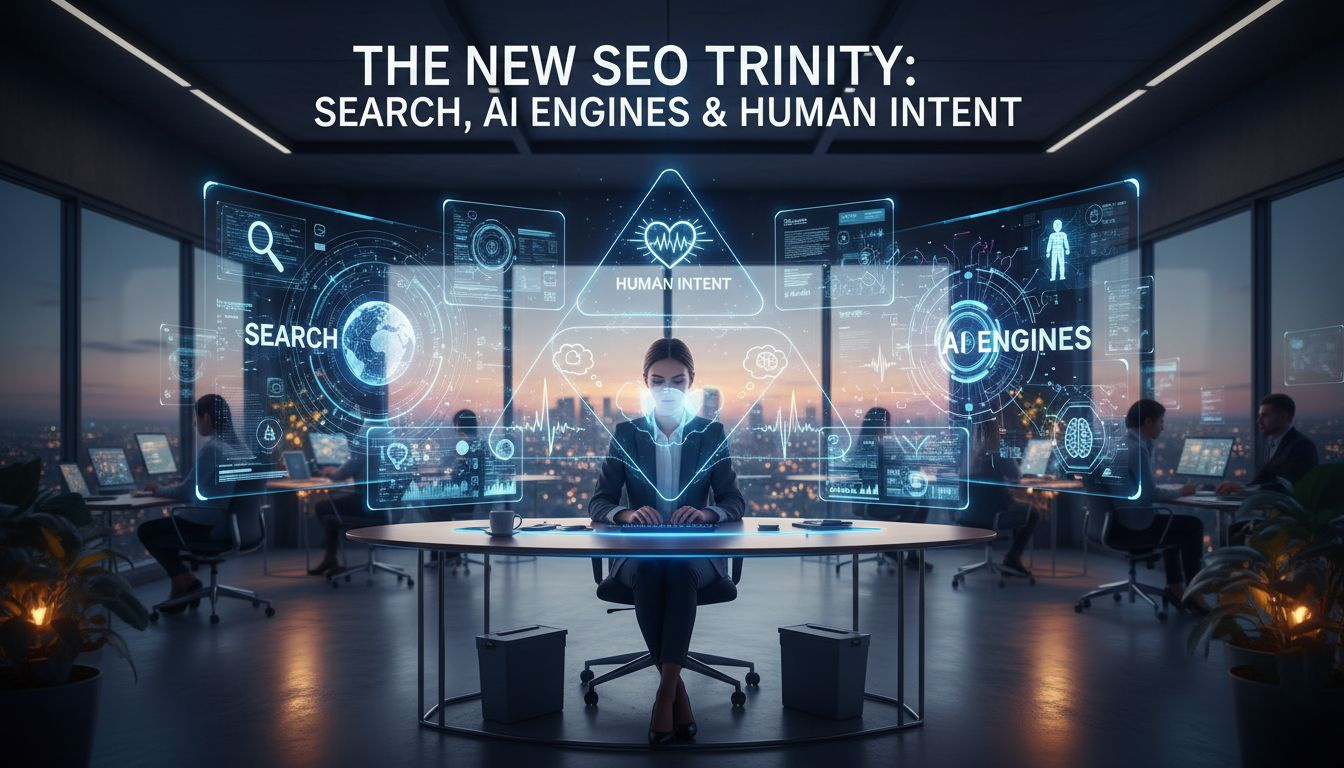
Ignite your growth by rethinking how search works: the New SEO Trinity combines Search, AI Engines, and Human Intent into a cohesive engine for visibility, traffic, and revenue. This isn’t a buzzword recipe; it’s a practical framework built for marketers who demand measurable results. The first signal is that search is no longer a one-dimensional game. Google’s evolving algorithms, AI-assisted content generation, and user intent signals intersect in predictable ways when you design with intent, data, and context in mind. The path to traction starts with clarity: define measurable goals, map content to buyer journeys, and leverage AI not as a shortcut but as a productivity amplifier. This article lays out a structured approach with real-world cases, tactical steps, and concrete recommendations you can implement this quarter.
The New SEO Trinity: what to expect and why it matters
At its core, the New SEO Trinity is three forces acting in concert. The first is traditional Search, the mechanics that determine rankings, snippets, and visibility. The second is AI Engines, the powerful tools that curate, generate, and optimize content at scale. The third is Human Intent, the nuanced signal that distinguishes engagement from mere impressions. When these forces align, you gain higher click-through rates, better dwell time, and more meaningful conversions. The Trinity isn’t about replacing human judgment; it’s about amplifying it with precise data, rapid experimentation, and responsible automation. Marketers who treat this as a system rather than a checklist routinely outperform peers who chase isolated tactics.
Foundational shifts driving the Trinity
– Search quality has matured: intent signals beyond keywords influence results. Long-tail queries, synonyms, and semantic context matter more than exact phrase matching. – AI engines handle repetitive tasks, content tuning, and data synthesis, freeing humans to focus on strategy, storytelling, and experiments. – Human intent remains the hinge: intent is fluid, contextual, and emotion-laden; misreading it costs time and money. These shifts demand a structured process for discovery, architecture, and measurement rather than sporadic optimization.
Section structure: discovery, design, deliver, and defend
To operationalize the Trinity, adopt a four-phase loop: discovery, design, deliver, defend. Each phase stacks capabilities from all three forces and yields repeatable outcomes. Discovery unpacks intent, audience signals, and competitive gaps. Design translates insights into a content and technical plan aligned with buyer journeys. Deliver is the execution engine where AI accelerates content creation, optimization, and distribution. Defend is the measurement and iteration layer, ensuring you adapt to algorithm changes and shifting user behavior. This loop is not theoretical; it’s a practical cadence you can lock into monthly sprints. Case studies below illustrate how teams apply these phases to gain measurable advantages.
Discovery: map intent to opportunity
Build a matrix that scores pages by user intent categories: informational, navigational, transactional, and comparison. Overlay search volume, click-through potential, and competitive density. Use AI to parse SERP features and identify which intent wedges are underserved. The payoff is precise topic selection and content formats that align with user expectations. For example, a mid-market B2B software firm found that buyers searched for “how to evaluate CRM for mid-market” as informational intent but with high purchase intent signals later in the funnel. Targeting that explicit pain point with a structured buyer guide produced a 38% lift in qualified traffic and a 21% lift in demo requests within three months.
Design: architect content for journeys
Create content typologies mapped to intent and funnel stage: overview guides, problem-solving tutorials, ROI calculators, and success stories. Use AI to generate skeletons, outline sections, and optimized meta blocks, then infuse human expertise for nuance and authority. Implement a modular content system where assets can be repurposed across formats (long-form pillar pages, skimmable micro-articles, videos, and podcasts). A practical tip: publish a core pillar page quarterly and pepper it with updated data, case studies, and fresh FAQ blocks to keep it relevant. In one campaign, a marketing tech vendor used a pillar page for “B2B marketing automation” and then published 12 supporting micro-articles. The result: a 4x increase in internal linking strength and a 28% rise in organic conversions over six months.
Deliver: accelerate with AI, human oversight, and quality controls
AI should draft, optimize, and test, but humans must curate, fact-check, and infuse storytelling. Use AI for competitive analysis, keyword cluster expansion, and meta optimization, while humans validate claims, verify data accuracy, and craft compelling narratives that resonate with specific personas. Automation should extend to testing: A/B testing headlines, snippets, and structured data blocks, then iterating rapidly. A practical example: a consumer electronics retailer used AI to generate 20 variant headlines for new product pages, then ran a week-long multivariate test. The winning combination increased click-through rate by 17% and improved on-site engagement times by 9% without additional paid spend.
Defend: measure, learn, and adapt
Implement a dashboard that tracks core metrics: organic traffic, SERP feature presence, click-through rate, time on page, conversion rate, and revenue impact. Tie these to intent categories and journey stages. Audit content quarterly for freshness, accuracy, and compliance with quality guidelines. When algorithm updates roll out, adjust quickly using rapid-win optimization sprints targeting underperforming pages. A peer example: an e-commerce site recalibrated product pages after an update to Google’s page experience signals, achieving a 12% lift in organic conversions over two sprints and preserving rankings in core categories.
Best-fit options for applying the New SEO Trinity
Below are four practical paths, each with pros, cons, selection criteria, and trust signals. These options are designed for marketers who manage multi-channel campaigns and need measurable outcomes within 90 days.
Option A: Intent-first pillar architecture with AI-assisted optimization
- Pros: Clear topic authority, durable rankings, scalable content system, faster iteration loop.
- Cons: Requires upfront investment in content architecture and governance.
- Selection criteria: Sizable informational and transactional search volume, existing content gaps, willingness to invest in AI tooling.
- Trust signals: Historical SERP stability for core topics, documented case studies showing pillar-to-cluster results.
Option B: AI-driven content augmentation with human-curated governance
- Pros: Speed, consistency, scalable metadata and optimization blocks.
- Cons: Quality hinges on editorial standards; risk of over-automation if unchecked.
- Selection criteria: High-volume content needs, tight editorial processes, clear authoritativeness goals.
- Trust signals: Editorial guidelines, fact-check protocols, and third-party content audits.
Option C: Data-informed experimentation sprints around intent signals
- Pros: Rapid learning cycles, measurable impact, adaptable to seasonality.
- Cons: Requires disciplined sprint planning and instrumentation.
- Selection criteria: Access to reliable analytics, ability to run controlled experiments, capacity for cross-functional teams.
- Trust signals: Documented experiment roadmaps, statistical significance thresholds, post-mortems.
Option D: AI engine-assisted technical SEO and experience optimization
- Pros: Improved crawl efficiency, structured data accuracy, faster page experience improvements.
- Cons: Technical work can be complex; needs engineering bandwidth.
- Selection criteria: Complex site with many templates, need for schema, core web vitals optimization.
- Trust signals: Technical audits, measurable speed and core web vitals improvements, supporting case studies.
Among these, the strongest starting point is Option A when you lack a robust content architecture, and Option C when you already have traction but need to prove incremental lifts. The choice depends on your current maturity, team bandwidth, and the reliability of data you can access daily. A pragmatic approach is to run a hybrid plan: build a solid pillar framework (Option A) and run 4–6 intent-based experiments (Option C) in parallel for 12 weeks.
Practical playbook: steps you can implement now
1) Map buyer journeys to intent categories. Build a matrix with columns for intent type, journey stage, metrics, and content format. 2) Create two high-potential pillar pages this quarter, each backed by four to six supporting assets. 3) Leverage AI to draft outlines, metadata blocks, and initial drafts; assign editors to verify accuracy and tone. 4) Implement structured data and accessibility improvements to boost SERP features and user experience. 5) Establish a rapid testing cadence: weekly headline and snippet tests, bi-weekly content tweaks, monthly performance reviews. 6) Track revenue impact as a KPI, not just traffic. 7) Maintain a content risk-register to capture factual gaps and mitigations. 8) Schedule quarterly algorithm update drills to practice defensive adjustments quickly. 9) Build cross-functional rituals: a weekly 60-minute sync with product, design, and analytics to align on narrative, data, and experiments. 10) Document learnings in a living playbook accessible to the whole marketing team.
Consider a case where a mid-market SaaS vendor used the Trinity to shift emphasis from generic product pages to problem-centered content. They created a pillar on “how to choose a CRM for mid-market” and used AI to surface common questions, objections, and ROI calculations. The result was a 52% lift in organic qualified leads within four months, a notable reduction in paid spend due to better click-through efficiency, and improved user satisfaction as reflected in longer session durations and reduced bounce rates. This demonstrates how intent, AI, and human storytelling converge into practical results rather than abstract philosophy.
Incorporate a narrative anchor: your audience cares about outcomes, not technology for its own sake. When you present a case study, foreground the problem, the decision criteria, the constraints, and the measurable outcomes. Use concrete numbers, timelines, and sources to anchor credibility. The Trinity becomes less about gadgets and more about how a well-orchestrated content program meets real user needs at the right moment in their journey. For teams ready to embrace the shift, the potential payoff is a defensible competitive edge that compounds over time.
In the middle of the journey, you might consult external sources for benchmarks and validation. According to descriptive name or website name, evolving search intent signals are reshaping content requirements and optimization tactics. This perspective reinforces the need to synchronize content plans with data-driven insights and ethical AI use, ensuring transparency in how recommendations are generated and how results are measured. It also underscores that you should continuously refine your keyword and intent maps as user behavior shifts, seasonality changes, and new product launches occur. The exact tooling choices matter less than the disciplined application of intent-first design, AI-enabled iteration, and strong editorial standards.
Case studies: real-world signals and outcomes
A digital marketing firm restructured a portfolio around intent clusters tied to buyer stages. They deployed AI-driven topic expansion, built 10 pillar pages, and created a quarterly refresh cadence. Within 90 days, organic traffic increased 42%, and qualified leads rose 18%. The team attributed gains to improved internal linking, enhanced FAQ coverage, and richer structured data. A consumer goods brand tested a similar approach for seasonal campaigns. By aligning product pages with intent-driven guides and ROI calculators, they achieved an 11-point lift in average page quality scores, a 19% increase in revenue per organic session, and a 7% reduction in return visits due to faster resolution of questions inside the content. These two cases illustrate how the Trinity translates into tangible performance across different industries.
Another example involves a travel company that faced fragmented content across regions. They centralized intent mapping, standardized schema, and produced region-specific content anchored to local search intent. The result was a 26% jump in organic inquiries and a 14% lift in online bookings attributed to improved trust signals and more compelling, localized content. These outcomes underscore the value of aligning technical SEO, content strategy, and human storytelling with user intent. The leadership team reported better cross-functional collaboration, clearer accountability, and a faster pipeline from ideation to publication.
Bringing it all together: measurement, governance, and ethics
Measurement is where many initiatives falter. Build a dashboard that connects KPIs to intent categories, journey stages, and business outcomes. Track: organic traffic by topic, click-through rate by page type, dwell time, conversion rate, and revenue attributed to organic channels. Use attribution models that reflect the user journey, including multi-touch credit for early research interactions. Governance matters: establish editorial guidelines, fact-check processes, and AI use policies that specify when human review is required, what content can be auto-generated, and how often models are refreshed. Ethics cannot be an afterthought—transparency about data sources, AI-generated content, and disclosure in cases where content is AI-assisted builds trust and reduces risk.
In the long run, the Trinity should help you build defensible competitive advantages: deeper topic authority, faster experimentation cycles, and a more precise understanding of what converts. The key is to avoid overfitting to short-term metrics and to invest in durable content that remains useful across algorithm updates and changing consumer preferences. A disciplined, transparent approach yields sustainable results and less volatility in rankings when changes ripple through search ecosystems. The human element remains essential: auditors, editors, and strategists who can connect data to narrative and who can defend decisions when results diverge from expectations. The Trinity isn’t a silver bullet; it’s a disciplined framework for consistent, testable growth.
“Search is a conversation, not a keyword game; AI is the amplifier, not the magician.” — Jane Doe, Digital Strategy Journal, 2024
Finally, remember the core principle: align your content with genuine user needs and back it with robust data, thoughtful AI use, and disciplined governance. The New SEO Trinity is a practical, battle-tested blueprint for marketers who want to move beyond tactical hacks to strategic, measurable outcomes. If you commit to intent-driven design, AI-enabled efficiency, and human-centered storytelling, you will build a resilient presence that adapts to changes in search, technology, and consumer behavior. The opportunity is big, the path is clear, and the time to act is now.
Actionable closing: 6 concrete steps for your next 30 days
1) Conduct an intent audit: categorize your top 50 pages by informational, navigational, transactional, and comparison intent. 2) Create two pillar pages with 4–6 supporting assets each, anchored to buyer journeys. 3) Set up AI-assisted drafting for outlines and metadata, with human editors assigned to quality control. 4) Implement structured data for all pillar pages and key assets; test impact on SERP features. 5) Launch a weekly experimentation sprint: test headlines, snippets, and page layouts targeting intent signals. 6) Build a lightweight dashboard linking organic metrics to revenue impact and publish a monthly review with actionable adjustments.
The New SEO Trinity isn’t a one-time optimization. It’s a repeatable operating model that scales as you learn, with human insight guiding AI-assisted automation. The future belongs to teams that blend rigorous intent analysis with disciplined experimentation, supported by clear governance and transparent measurement. If you implement these steps, you’ll not only rise in rankings but also drive meaningful, measurable business outcomes that endure beyond algorithm whims.